











Where can I find information about the ADA and other general information relating to living with a disability?
New England ADA Center - one of 10 regional ADA Centers comprising the, providing information, guidance and training on the Americans with Disabilities Act (ADA), tailored to meet the needs of business, government and individuals at local, regional and national levels. See https://www.newenglandada.org or call 800-949-4232 to get your ADA questions answered.
National Council on Disability -Frequently Asked Questions - https://ncd.gov/resources/faq
National Council on Disability - Resources - https://ncd.gov/resources
Where can I find information about accessible housing and building and interior space design?
Independent Living Centers (list) - https://www.newenglandada.org/independent-living-centers
Institute for Human Centered Design - provides education and consultation about best practices that go beyond legal requirements to design places, things, communication and policy that promote design that works for everyone across the spectrum of ability and age and enhances human experience. See https://humancentereddesign.org or call 617-695-1225.
Public Transportation
Is the MBTA accessible? Not all MBTA transport modes (bus, subways and trolley, commuter rail, ferries) or MBTA stations are accessible. Comprehensive information on accessible stations, routes, etc., as well as information on planning your trip using the MBTA is available at https://mbta.com/accessibility.
What is The Ride? The RIDE is the MBTA's door-to-door, shared-ride paratransit service. If you have a disability that prevents you from using the MBTA bus, subway, or trolley all or some of the time, The RIDE may be able to assist with your public transportation needs. Out-of-town visitors with disabilities may also be eligible to use The RIDE.The RIDE is available in 58 cities and towns in the greater Boston area, with similar operating hours to the MBTA-generally from 5 AM to 1 AM daily. To access The RIDE, you have to apply and be approved by The RIDE Eligibility Center (TREC). Once approved, you can schedule trips from 1 to 7 days in advance. See for more information, including fares and how to apply. See https://mbta.com/accessibility/the-ride
Handicapped Parking - Questions & Answers
Why are some
handicapped parking permits plates and others' placards?
A: Personal choice. There are two types of handicapped permits: one is
a placard that must be hung in the center of rear view mirror, and is
transferable from car to car. The second type is a plate permanently attached
above the bumper.
Placard etiquette: The individual it is issued to must be present AND EXITING the vehicle. If you are picking up a prescription for a disabled person, you may NOT use the placard as he/she sits in the car. (Fine =$500)
Why are there
striped off areas adjacent to a blue handicapped space? 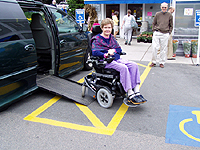
A: This is called the crosshatch area. Many disabled people do not have
the range of motion to bend their legs; the door needs to be fully ajar
to exit the vehicle to utilize a cane or crutch. This is most importantly
the case when a wheelchair-user needs to pull up the chair tightly into
that open door to perform a transfer or to re-assemble the chair in reach.
Wheelchair users who must stay in their chair need the space to accommodate
the ramp.
Cross Hatch area etiquette: Every proper disabled space comes with this loading zone. This is never a place to park - with or without a permit! When the zone is blocked, the disabled driver cannot get back into the vehicle until YOU return. It is also not a place to shovel snow into or leave a grocery cart. (The photo demonstrates the need for a "Van Space" - an adjoining larger loading zone for a van to deploy its 3ft ramp and a turning radius to exit off that ramp.)
Van Space etiquette: If you have a permit and a car, please take the NON-van space first. If you see a van taking up two regular spaces, they are not being rude; drivers may do this when left with no other choice. Imagine if YOU could not exit your car once you arrived at your destination.
Sometimes I
see people using disabled spaces with permits but they sure don't
LOOK disabled, how is it they get a space?
A: There are many invisible disabilities to be mindful of. The gentleman
who appears to walk fine and without aid, may have a prosthetic leg under
his chinos. The 40-ish woman may have M.S. and needs to be back in air
conditioning quickly to avoid a flare up of symptoms on a hot day. It
is possible that the elderly man with a lively step is recovering from
coronary disease. But if you suspect otherwise, you can always write down
or photograph the permit and contact the RMV at 857-368-8000 or online
at https://
mass.gov/how-to/report-disability-parking-abuse.
Is it safe
for disabled drivers to be driving and how do they drive anyway?
A: All drivers who
have sustained an injury to one or more limbs loses his or herright to
drive, UNTIL they return to the RMV with adaptive equipment and take and
pass a "Competency Road Test". If you suspect that a driver
should no longer be on the road, urge the family of that driver to sign
up for a Competency Test (617-351-9222). The test could point out something
as simple as the need for new eye glasses!
Disabled driving etiquette: Many newly disabled individuals falsely lose all their independence because of a lack of understanding of the full range of equipment that can get a cognitively competent driver back on the road to his or her independence. Please seek our Marblehead Disability Commission for resources, We are here to help.
Town
of Marblehead ADA Grievance Procedure (.pdf)
Who We Are || History || Common Questions || Resources || Things To Do || Make Your Home Accessible || Links to Organizations || Site Map
Email: Information@marbleheadable.org
Website Disclaimer & Privacy Policy